Stricter short-term rental enforcement gets mixed reactions from residents
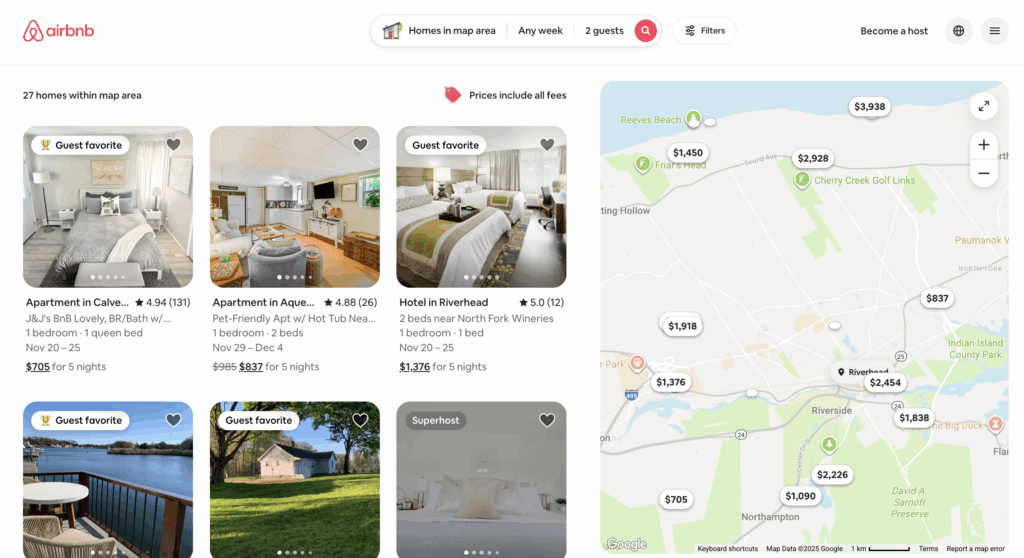
Riverhead presented beefed-up short-term rental regulations Tuesday that would use advertising of rentals under 30 days as acceptable evidence to trigger harsher fines, and allow enforcement based on listing language alone.
The proposed revisions — which were discussed at public hearing scheduled during the Town Board’s Nov. 18 meeting — include expanding the rules for rental permits, prohibiting advertisements of rentals under the 30-day term and bumping up penalties and fines for violators. The changes would give code enforcement the proper tools to be able to review rental permits and conduct investigations.
“It’s come a long way since we had to take an undercover police officer with a town credit card go and make a transaction with the owner of the AirBnB, to get that into court [and] to prove the case in court,” said Riverhead Town Supervisor Tim Hubbard. “[The code revisions] are going to alleviate some of the need to do that, and it’ll make it a lot easier to prosecute a case.”
Community reactions to short-term rentals crackdown
There were mixed reactions from residents at the town board meeting, a majority of which expressed their support for the proposed code changes.
Bob Klein of Aquebogue, who joined via Zoom, commended the town for the stronger enforcement and shared his experience living next to controversial “Victorville by the Sea” rental property on Overlook Drive — the one Mr. Hubbard confirmed required an undercover operation in order to bring the owner to court. Riverhead Town sued the property owner in 2020 and settled the litigation this year.
“Victorville by the Sea” advertised rooms on Airbnb and Instagram, where they said the property could be rented as both a hotel and/or a bed and breakfast. It was publicized it could sleep up to 45 people and rent out 16 rooms, Mr. Klein said.
“It vastly increased the traffic in our area. Cars were parked on both sides of the street, and we couldn’t get emergency vehicles through,” he recalled. “We had strangers going through the neighborhood, we had noise from parties going to three in the morning, and trash eight times [more than] what a normal resident would put out.”
Mike Jones, a Riverhead resident for 10 years, said he was surprised to hear about the “extreme measures” on short-term renters.
“We pay property taxes, we’re citizens of the community, sometimes [renting] is for people that need additional income,” Mr. Jones said on Zoom.
Although the public hearing was more about the enforcement and upped fines added to the code, Zuleika Hines and other residents asked town officials to consider allowing 14-day rentals.
Ms. Hines argued that not only do short-term rentals boost tourism and bring economic benefits to the town, but they can serve as temporary stays for those working in the area or are in need of medical services at Peconic Bay Medical Center.
It’s very uncomfortable to live next to a person that continues to violate the law and you don’t have peace of mind,” Ms. Hines said. “Those are very true concerns to have, but we have to find a middle ground.”
The written comment period is open until Friday, Nov. 28.

Proposed short-term rental enforcement changes
The Riverhead Town Board first enacted the law banning rentals of fewer than 30 days in 2013, after neighbors of such rentals complained they were turning into “party houses” and were operating as commercial establishments in residential areas. The town was among the first Long Island municipalities to implement a formal rental permit system that also requires a town inspection.
“The Town Board finds that rental of residential units for periods of less than 30 days undermines residential zoning, disproportionately draws upon Town resources and services, and/or disrupts the peaceful, quiet enjoyment of property by residents of the Town in a manner inconsistent with the Town Board’s obligation to protect and promote the health, safety and welfare of the Town’s residents,” the revised code states.
In the updated code, town officials added that any property listed or advertised on a public rental platform with a minimum stay of less than 29 days would be presumed for transient rental purposes and in violation of town code.
Language in the advertisement suggesting weekend availability or weekly rentals, per-night rather than monthly rental rates, and observations of groups occupying the premises on a rotating basis, excessive trash being put out inconsistent with single-family occupancy, and frequency of different vehicles going to the property would also be seen as likely evidence of a transient rental.
Any one or more of the criteria listed in the revised code would be sufficient for Riverhead Town to establish a “rebuttable presumption” that the property is in violation, regardless of whether the rental activity actually occurred.
This rebuttal could be used as evidence in any enforcement proceeding, including prosecutions in town justice court, civil actions in Supreme Court or administrative appeals before the Zoning Board of Appeals. The property owner can rebut any claims in court, as long as they present clear and convincing evidence they are not renting transiently.
Advertisements for short-term rentals under 30 days in Riverhead would be illegal in the updated code, with each day of advertising for the rental unit constituting its own separate violation. All rental advertisements would be required to have a valid, town-issued rental permit number.
Town attorney Erik Howard added that the code amendment requires those who apply for a rental permit to sign an affidavit acknowledging that they are aware of the prohibition on transient rentals, and the consequences of being in violation, including that the rental permit can be revoked.
A town code enforcement officer can also suspend, revoke or deny a rental permit upon finding a violation of the transient rental code. Any platforms that fail to remove a prohibited listing after receiving a formal written notice from Riverhead Town would face civil penalties. The increased fines for violators would be as follows:
- First offense: Minimum fine of $3,000, maximum of $15,000, 15-day imprisonment, or both.
- Second offense: If committed within 18 months of prior conviction, violators face a minimum $5,000 fine, maximum $20,000, 15-day imprisonment, or both.
- Third offense: Those who commit a third or subsequent offense within five years of a prior conviction will be punished with a minimum $10,000 fine, a maximum $30,000 fine, 15-day imprisonment, or both.
In addition to criminal penalties, the town may pursue civil action and fines up to $5,000 per violation per day, as well as injunctive relief.
“Before, the penalties were low enough that if you get caught doing this, and you either plead guilty to it, or you pay a fine, it sort of becomes the cost of doing business,” Mr. Howard said. “The point is, this makes the penalties more than just the cost of doing business for the person who is repeatedly engaging in this conduct.”